Blog
The Topical Finasteride Reality Check


Topical finasteride may reduce scalp DHT and improve hair counts, but “topical” is not the same as “local only.” The evidence, product status and safety conversation require careful separation.
Topical finasteride occupies an unusual position in the hair-loss market. It is familiar enough to sound established, convenient enough to be marketed through telehealth and medically plausible enough to attract people who are reluctant to take an oral drug. Yet in the United States there is no FDA-approved topical finasteride product.
That distinction does not mean topical finasteride has no evidence. It means the evidence for an ingredient and formulation must not be confused with approval, quality or labeling of every product sold under the same name.
 Finasteride inhibits 5-alpha-reductase, reducing conversion of testosterone to dihydrotestosterone (DHT). DHT contributes to miniaturization in certain types of hair loss. Oral finasteride has long been approved in the United States for male pattern hair loss.
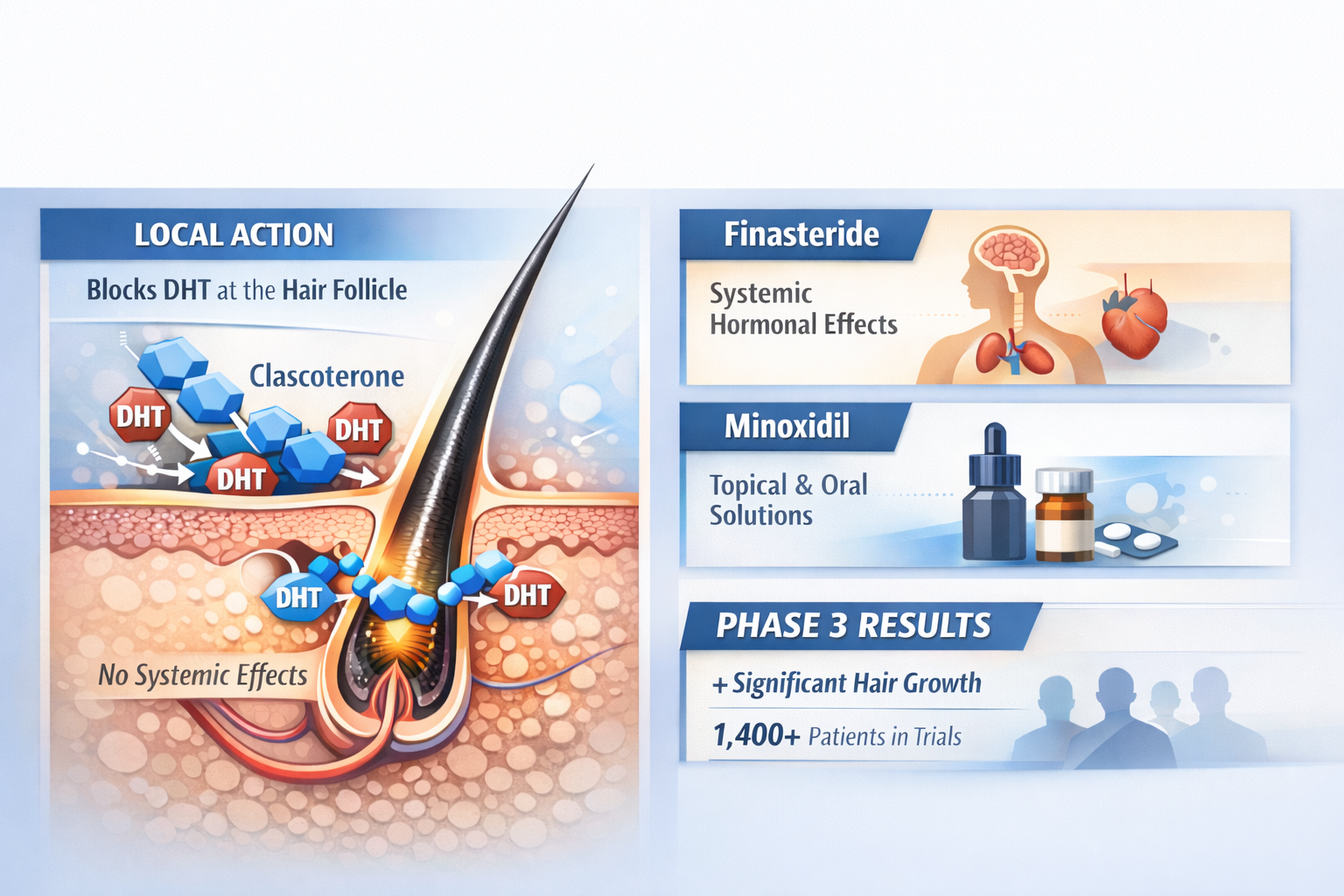
The topical strategy aims to deliver the same activity at the scalp level while limiting whole body exposure to the drug.
Clinical studies have reported improvement in hair counts with some topical formulations. A randomized Phase III study published in 2022 found a topical finasteride spray superior to placebo and described the results as similar to oral finasteride, with substantially lower plasma exposure. Reviews published since then have continued to evaluate topical finasteride and dutasteride as potential hair loss options.
The phrase “lower exposure’ does not mean “no exposure.”
What the FDA warning changed
In April 2025, FDA alerted health professionals, compounders and consumers to the potential risks associated with compounded topical finasteride.
 The agency stated that it had received 32 adverse-event reports between 2019 and 2024 involving compounded topical products, including sexual, neurological and psychiatric symptoms consistent with known concerns associated with systemic finasteride exposure.
Reports cannot prove the cause on their own, but they are a safety signal—not evidence that the products are risk-free.
FDA also highlighted local irritation and the possibility of unintended transfer to others. This is particularly important because approved finasteride products are contraindicated in pregnancy due to risk to a male fetus. A liquid or gel applied to the scalp can contact hands, pillows, countertops or another person unless use and storage are carefully managed.
 The FDA alert emphasized three facts:
 The FDA alert emphasized three facts:
- No topical finasteride formulation is FDA-approved in the United States.
- Compounded drugs are not reviewed by FDA for safety, effectiveness and quality before marketing in the same way as approved drugs.
- Skin application is expected to produce some systemic absorption.
Why one topical product is not interchangeable with another
Topical products can differ in concentration, dose volume, vehicle, applicator, frequency, added ingredients and pharmacy quality controls. Those differences affect delivery and exposure.
A clinical trial of a metered spray cannot automatically validate an independently compounded dropper bottle used at another concentration or in combination with minoxidil, tretinoin or other ingredients. The active ingredient may be the same while the actual product is not.
Consumers should know the exact concentration, prescribed dose, total daily exposure, pharmacy and prescriber. “A few drops” is not a sufficiently precise instruction when dropper size and formulation vary.
Your professional role
Non-medical hair professionals will probably find clients using topical finasteride. Their role is not to recommend a prescription, interpret side effects or tell a client to stop treatment. It is to recognize practical issues and refer questions back to the prescriber and dispensing pharmacy.
Useful questions include:
- Is this an FDA-approved product or a compounded prescription?
- What exact concentration and daily volume were prescribed?
- Did the prescriber discuss systemic and local adverse effects?
- What instructions were given to prevent transfer?
- Who should the client contact if irritation or other symptoms occur?
- Will adhesives, solvents, occlusion or frequent scalp cleansing affect use?
The last question matters for system wearers. Applying a medication beneath an attached system may change contact time, migration and skin condition. Adhesives or cleanup products may irritate the same area. The prescriber and hair-replacement professional should understand the combined routine rather than leaving the client to improvise.
What balanced communication sounds like
It is inaccurate to say topical finasteride is ineffective because it lacks a U.S. approval. It is also inaccurate to say it carries no systemic risk because it is topical.
A better explanation is:
 “Studied topical formulations have shown evidence of benefit, and some trials have reported lower systemic exposure than oral treatment. In the United States, however, no topical finasteride product is FDA-approved, compounded formulations vary, absorption occurs and FDA has reported safety concerns that require informed prescribing and careful handling.”
That sentence is less marketable than “all the benefit without the side effects.” It is also more honest.