Blog
Hair Transplant Assistance


ARTAS Robotic Hair Restoration System
The world’s only robotic system in aesthetic medicine was developed by Restoration Robotics, Inc. (HAIR) and originally FDA approved in April 2011. In this interview, The International Hair Authority talks with Restoration Robotics® CEO, Ryan Rhodes and COO, Gabe Zingaretti to learn about the company’s new ARTAS iX System.
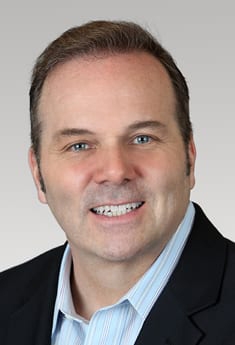

Hair Authority: New technologies have been transforming medical procedures for many years now. We are accustomed to robotic assistance in the operating room for critical procedures like heart surgery and pro-active tests like scanning the skin to detect early signs of skin cancer. So robotic assistance in hair transplantation seems a very logical development. But hair transplantation is unique in that it is a marriage of precision surgery and artistic vision. To compound the situation, the physician not only has to bring those two skills together, but he or she must also have the experience and vision to create an aesthetic outcome that will look good today… and in ten- or twenty-year’s time. That’s quite a challenge.
Ryan Rhodes: Yes, it is. And that’s why Restoration Robotics is committed to ongoing education for our physicians. Without trained physicians, we cannot deliver the high-quality clinical outcomes that we stand behind as a company. The ARTAS Robotic Hair Restoration System is a cutting-edge technology that offers machine-based vision, machine learning… all the key technology buzz words. But, at the end of the day, it is really a tool to assist physicians. The key to a successful outcome is still the skill of the operator, in this case, the hair transplant surgeon.
Authority: Robots are used in all kinds of critical surgeries. Before we discuss the special needs of hair transplant patients, could you describe the role of robotics in medicine today.
[rml_read_more]
Ryan R: There were over a million surgeries performed globally by surgical robots last year. Just look at the data from Intuitive Surgical where I spent a good portion of my career, or companies like Mako Stryker, Mazor which is owned by Medtronic which is in other spaces such as bone, spine and skeleton. There are approximately 50 companies either in a state of development or that have already brought robotic technology to market. The majority of them are still in a development phase and our COO, Gabe Zingaretti and I discuss this a lot. Big companies like Google, Johnson and Johnson, Kawasaki, Medtronic are all actively involved. This is not some future fascination, it’s already happening. Robotics are proliferating in medicine right now and research reports put the market as high as $21 billion by 2024. That’s only five and a half years from now!
Authority: What’s driving this growth?
Ryan R: Surgery is always about the patient having a positive and efficacious outcome. From a surgeon’s perspective, it’s all really about precision, reproducibility and efficiency. This applies to what you do step by step, how you approach anatomy and how you approach your dissections. It’s also about efficiency. Robots can act quickly without any loss of precision.
Authority: And robots do not get fatigued or suffer from stress and anxiety.
Ryan R: Robots can be very precise. They can be reproducible, and they can increase efficiency through optimization of workflow because surgery, at the end of the day, even a hair transplant, is a series of defined steps that are done in a sequential order. You do this first, followed by this, followed by that. Computer assisted surgery is a tool that can help a physician deliver something that is precise, reproducible, and efficient.
Authority: How did hair transplantation come to the attention of Restoration Robotics?
Ryan R: That’s why I have Gabe Zingaretti, our COO here with me. He’s been with the company longer than just about anyone else, so I’ll let Gabe answer.

Gabe Zingaretti: I’m COO at Restoration Robotics and I’ve been with the company for ten years now. The company was founded by Dr. Frederick Moll, who also co-founded Intuitive Surgical and several other robotic companies in the Bay Area. Dr. Moll collaborated with Dr. Mohan Bodduluri and they joined ventures to create a robotic hair restoration device. Funnily enough, the original idea was based on strip harvesting. They planned to automate slivering a strip and turning the slivers into follicular units for placement. That’s how the whole thing started, but when they analyzed the process, they asked themselves what the point was of cutting a strip and putting it under the microscope then having a robot dissect it when it was already on the patient in the first place. It seemed to them that it made better sense to do it there. So that’s how idea started. They got a bit of an uplift too from the growing acceptance of FUE, due in part to papers published by Drs. Rassman, Verman and Bernstein. They foresaw that robotic activity based on FUE harvesting was the way to develop the technology.
Authority: This turned out to be the perfect storm because FUE was fast growing in popularity while you were doing your initial research.
Gabe Z: Exactly. We started with just a piece of silicone and some little metal sticks. Those were our first hair prototypes. We went to work developing the technology and by 20016, we had a system that was ready for a feasibility study.
Authority: Apple learned that the technology alone is not enough, you have to offer the consumer a meaningful benefit. How do you reach out to a man or woman considering a transplant and say this procedure is better than what went before?
Ryan R: There are meaningful benefits for the consumer, but again, this is a support technology, not a replacement technique. It is an important tool, but its success depends on the user of the tool. Experience in hair restoration techniques is important, as is a commitment to delivering high quality aesthetic outcomes. For a patient, the best scenario would be based on a doctor who specializes in these procedures and has a lot of experience. He or she knows hairline design. They understand the different degrees of hair loss and what can be given to that patient. They are realistic and do not set the patient’s expectations too high. When you combine that experience with the ability to deliver a precise, reproducible, efficient procedure using cutting edge technology, then the patient is getting the best of all possible worlds.
Authority: Like all science, robotics to power to transform lives, but only in the right hands.
Ryan R: I guess what I’m saying is it’s a great technology, but the limitations of any technology is around who is using it.
Authority: Perhaps a parallel would be an airline pilot where whose role has been totally changed. It’s no longer about mastering the navigation or flying techniques, it’s now about creating a satisfying customer experience; comfortable seats, in-flight entertainment, arriving on time. With hair transplantation, the role of the surgeon is also changing. It’s no longer about placing the graft. It’s about the creative vision, knowing how your hair will thin in the future and planning ahead. Just like the pilot, doctors must understand your lifestyle and expectations, then use the latest technology to deliver it.
Ryan R: Yes, I would say it’s very similar to that. The company name, ARTAS, means the ART and SCIENCE of robotic hair restoration. There’s the science, but there’s also an art. The art of the hairline design. For example, is somebody who’s Norwood 6 an appropriate candidate based on the available donor hair? I like your analogy because years ago, when I was still working for my last company, Intuitive Surgical, I got a call from a patient who was a pilot for Southwest Airlines. My immediate response was to talk about the technology and explain what the robot was. And he goes, “No, no, no, I don’t need to know any of that. I’ve been flying planes for 35 years. I flew planes when we didn’t have computer-controlled avionics. We actually landed the planes. We took off. You don’t have to explain that to me. I just want to know who the best physician is in my market using your technology.” That was a wakeup call for me. There are a lot of things that pilots do that we’re unconscious of. They’re just done. Planes have gotten very sophisticated and he’s grown into that. He’s adapted to that in his career and understands the role of computers, modulated avionics and things like that. The ARTAS System is similar. Our robotic system has definite advantages, but still, at the end of the day, there’s an operator behind it that needs to make sure that the patient receives an appropriate transplant based on their hair loss and available donor hair.
Authority: A lot of physicians are nervous about automation in hair transplantation. They view it as a threat.
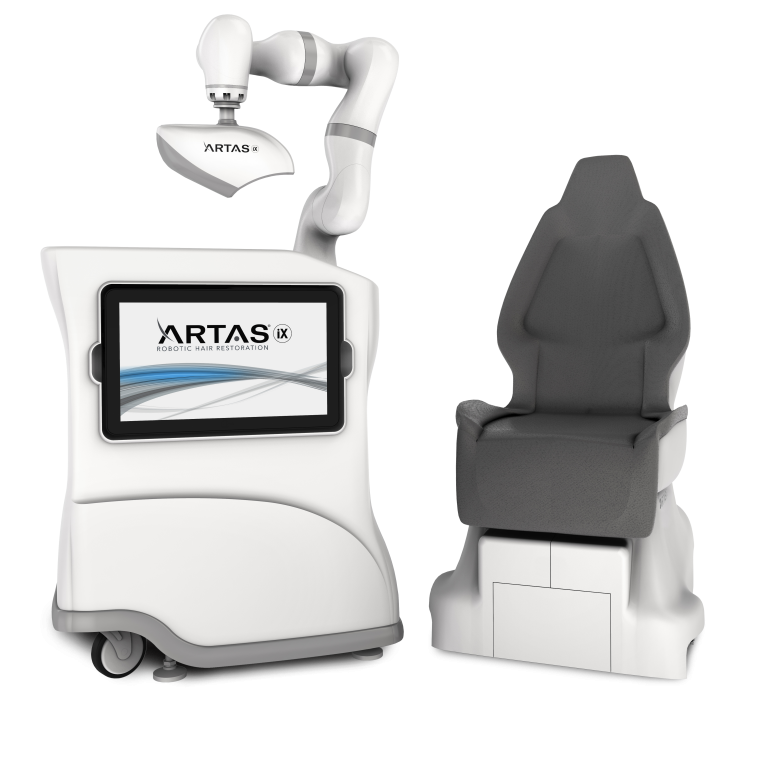
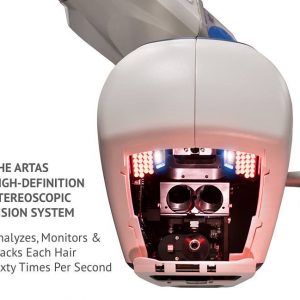
Ryan R: They need to understand that at the end of the day, it’s another tool in their armamentarium. The robot is there to assist the physician. The ARTAS System has an advanced vision system that is able to scan the area 60 times per second and see to 44 microns, approximately half the width of a hair follicle. Humans can’t do that. Additionally, robots never get tired or have bad days, they are able to perform thousands of extractions with precision and in a reproducible manner. The ARTAS System also helps to eliminate human fatigue which can lead go human error. We’re not eliminating the physician. The physician is the one who prescribes the treatment plan. The physician understands what they’re going to have the robot deliver in terms of harvesting hair, making sites or implanting grafts. The physician shouldn’t fear the technology. They should embrace it and understand how it may bring value to them in their practice. You mentioned that a recent survey revealed that 80 percent of doctors frequently use assistants to place grafts. That leads to the question, how many non-physicians today may also be harvesting the grafts? And if that number is similar, then you have to ask the next question, who is that person and do they have sufficient training? Do they have the skill? Do they care? Do they get tired during the procedure? Do they have surgical fatigue, eye strain, neck strain, muscular, skeletal challenges?
Authority: We know one company that routinely pauses procedures, so their medical assistants can do stretching exercises and relax before they continue. We don’t know about all the others.
Ryan R: At the end of the day, you want a physician who remains alert and focused on the treatment. The robotic system helps the transplant team throughout the procedure.
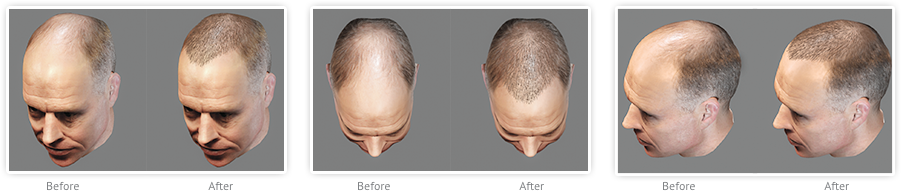
Authority: ARTAS can also help the doctor plan ahead because you offer supporting software that allows the patient to preview the results they can expect based on their available donor area.
Ryan R: That’s right. We want to make the entire experience as seamless as possible. It starts with realistic expectations and finishes with precise, vigilant surgery. That’s what we’re all about.
Authority: How has the hair transplant industry reacted? Is ARTAS perceived as an ally or a competitor?
Ryan R: Good question. And one I encountered once before in a similar situation. When I was working at Intuitive Surgical, the company that developed the Da Vinci system, the number one robotic surgical system in the world, a lot of doctors felt threatened. They didn’t understand the role of the Da Vinci. They valued the precision, reproducibility and efficiency, but they were concerned that robots might replace them in the operating room. Of course, that never happened and as they worked together, they found that that procedures became more efficient and more successful. They realized the argument wasn’t about being replaced by robotics, it was about how this tool could help deliver a better outcome for the patients. We also discovered another important benefit. As physicians grow older, they may have a wealth of experience, but, like all of us, they often lose some manual dexterity. However, a robot allows them to extend their career and continue to operate without any loss of precision. It’s a win-win for everyone. Patients benefit from the doctor’s lifetime of experience, and the doctor continues to deliver tightly controlled, precise surgery.
Authority: Where is your marketing thrust at the moment? Are you focused on the benefits for hair loss professionals or are you now reaching out to the public to suggest they seek ARTAS clinics because they guarantee a better experience?
Ryan R: We have to be careful with the word “guarantee.” I don’t think we can guarantee anything. FUE is a repetitive procedure. We take care of the fatigue, the monotony and the doctor takes care of the vision, the masterplan. So, we believe the patient is more likely to have a successful procedure. But back to your question, we have the only robotic system in the world in aesthetic medicine today and we need to communicate the benefits to both audiences at the same time, the public and the professional. We’re still a newcomer to hair transplantation and although robotics is growing, we are still messaging to physicians, so they understand the advantages of using ARTAS. But we’re also talking to patients because the technology needs to be demystified. We did a lot of focus groups at my last company and we learned that the concept of robotics can still be a little scary. Patients sometimes think that the doctor is not involved even though it’s the doctor who is the person prescribing and monitoring the entire treatment.
Authority: The public is already doing things like creating a “smart home” or “Facetiming” with friends, so the tech industry is working with you to build familiarity and confidence in new technologies.
Ryan R: There’s certainly a broad acceptance of automation today. We have robots that vacuum our carpets. There’s even a robotic system that will mow your lawn. And there’s a lot happening in medicine too that people don’t know about. That’s why we’re marketing to both stakeholders; the physician community concerning the advantages robotics can bring to their practice, as well as the patient.
Authority: You mentioned earlier that you are introducing a new ARTAS device. What’s new?
Ryan R: I’ll let Gabe tell you about this. He’s been leading the development team and bringing this new platform to market.
Gabe Z: The ARTAS iX System name was created by Ryan and it stands for implantation and extended capabilities. Every new release gets an update suffix, like ARTAS 4X, 5X or 6X. We spent three years developing the ARTAS iX platform. It took that long because we needed to develop implantation. We had to conduct a new clinical study to prove to the FDA that we could not only harvest the grafts and then implant them robotically, but we also had to demonstrate that we were just as good as when you implant them by hand. Hairs don’t grow overnight, so that that process took 9 to 12 months. We first developed the technology for the viability study and then proceeded with the formal case study. We treated 36 patients in a multicenter control study and finally secured clearance in the first quarter 2018. Artas IX is the only medical robotic device that is cleared for both harvesting and robotic implantation today. But our R&D didn’t stop there. We had so many new features that the company decided to re-engineer the entire platform. We started with a smaller footprint – the new system is half the size of its predecessor and much quieter.
Authority: Placing grafts is perhaps the most challenging part of the surgery. How do you get the angles right and match the natural flow of the hair?
Gabe Z: We have two very sophisticated algorithms that are driven by positional intelligence. The physician inputs the desired angles for the hair and the system prepares to implant based on what it sees. It analyses the density of the patient’s local terminal hair, which is the hair that is going to keep growing, and factors in the local ballast hair that is going to disappear over time. It then computes the optimum graft density and placement based on the doctor’s instructions.
Authority: Where do we go from here? Robot-assisted surgery has been a premium device for doctors who want, and could afford, to be on the cutting edge. But it’s now making its way into the broader hair transplant world. Is the next step dermatologist’s offices and then GPs?
Ryan R: We’re committed to working with ISHRS and its members, including the American Board of Hair Restoration Surgery. The global hair transplantation market conducted over 630,000 procedures in 2016, about 130,000 of them in the US. We want to work with doctors today who already do hair restoration but don’t own our technology. We think we could help them, and we would love to have them as our customers. That’s our first and primary focus. Many members within ISHRS are dermatologists trained in hair, nails, and skin and they understand skin surgery and disorders of the scalp. We also work with other specialists like plastic surgeons, ENT facial plastic physicians, people who work in the region of the neck up. They understand that hair frames your face and changes your looks.
Authority: Right now, you extract and place follicular units. You also have software that lets patients envisage what they might look like based on their available donor hair. Could you expand your service to provide an initial video analysis, perhaps in a booth somewhere in a remote location, then generate a report that explains what the transplant options are, then display a creative forecast showing the cosmetic end result, and finally make a referral to a doctor to perform the procedure. You would be providing a beginning to end consultation, analysis, creative proposal and medical introduction.
Ryan R: That’s a great concept and it would be absolutely feasible at some point. We looked at something like that back in 2015, if I remember correctly. It was a project called Hair Studio. The goal was to take the consultation experience to a different level. Today, if you go in for a consultation, most doctors will probably show you before and after photos of somebody with a similar type of hair loss or share the results of other patients. They may also mark your forehead to suggest where your new hairline could be. But it’s not an exact science. It could be improved. Hair Studio wanted to develop tools that would allow the consultant to walk around a person with an iPad and render a high-fidelity 3D model in about 40 seconds. Then he would draw on that digital image to show how you could look like with a prescribed treatment based on your donor hair. But it’s not that simple. It’s not just a question of aesthetics, you’re also working against the constraints of what people are able to afford.
Authority: Most people simply want more hair, lots of it, and they want it now. But often they ask for it too soon, or want more than is appropriate for their age. You have the technology that could provide answers to all of that.
Ryan R: It would, and I think that’s where things get more exciting. But I think ultimately where this goes is that an application like hair studio will look at all your features. It’ll look at your nose. It’ll look at the measurements between your eyes, your ears, your head. It’ll look at the donor area and it propose the optimum treatment for you. It’ll take a lot of the guesswork away. As it matures, the software will become more interactive and allow patients to fine tune it, for example people who have their signature hairlines. I don’t think robotics will remain exclusive to hair transplantation. However, we have an easier task than most other forms of surgery. Gabe and his team have developed a highly sophisticated program that registers the fixation of the skull. The rigidity of our skull facilitates all kinds of automation compared with robots working in soft tissue in our bodies. They encounter lots of movement. You have blood flow. You have respiration. You have peristalsis. These organs are always moving. You eat something. Your organs start moving and start the process of digestion. But working on the skull allows us to be very accurate as long as we have fiducials, which we built into the system. The fiducials have real time recognition of where that patient is, the orientation of their scalp, which fortunately for us is fixated at the skull. Since we have all this complex information, it doesn’t matter if a patient coughs, sneezes, needs to go to the bathroom, wants to get a drink of water, whatever, the robot can stop in real time. When the patient settles back down, it goes back and creates an accurate registration of the workspace and starts working again. It knows exactly where it left off.
Authority: And, as you mentioned, there are other head and scalp-based technologies ready to be exploited by someone.
Ryan R: You are right, and I’ll tell you why. If I go to a Target store or a box chain store, I can take an item, walk up to a scanner and check the price. Why couldn’t I put my head in a box for 30 seconds and have that analyze my hair and tell me what I should do about it? Maybe recommend a shampoo, recommend some hair vitamins, go get PRP if that’s recommended, go on finasteride, but go see a hair expert obviously.
Authority: That’s probably where it’s going to end up.
Ryan R: Years ago, I was reading a men’s magazine. I think it was either GQ, Esquire, and saw that Brooks Brothers had put a system in their flagship New York store that created a 3D model of you and then cut a suit off the accurate 3D model. I booked an appointment on my next business trip to go have this experience. When I arrived, they actually gave me underwear to wear and I was escorted to this booth and the girl said, “You shut the door. You stare at that dot in the ceiling. You pull these two things out from the wall.” The things were little handles and they moved your arms away from the side of your body. One of them had a trigger mechanism and the assistant told me, “when you’re still and ready, hit the button and just stare at the dot. It’s only going to take ten seconds.” So, I said okay and did exactly what I was told. As soon as I hit the button, the lights went down and it looked like a laser show for a bit and then the lights came back on. I put my clothes on, walked out and there she was on a computer screen looking at a spinning a hologram of me. I’m not making this up. And this was probably 14 years ago!
Authority: All that was left was choose the fabric.
Ryan R: So now she goes, “Now we will start the process of taking your body and building a perfect fitting suit around you,.” And that’s basically what they did. You just pick the fabric and they send you your new suit with 90 percent of the tailoring done. You only return to the store for a final fine-tuning. I thought that was a cool thing on so many levels and it was less expensive than regular customer service.
Authority: That is an imaginative and elegant note to finish on, but before we turn off the microphone, do you have a final footnote?
Ryan R: A couple things. First off, Restoration Robotics as a company is 100 percent committed to hair restoration. This is what we do. We don’t do other things. We focus on hair restoration, specifically FUE. We believe technology is evolving very quickly and our platform is just one example of where robotics is going. There are now robots in dental applications and in many other surgeries. It’s becoming more and more accepted; more and more common. We’re a technology company, but we’re also a patient outcomes company. The technology is only as good as the user. We’re excited to work with ISHRS and continue the path of further advancing robotic hair restoration.