Blog
Making It in Hollywood


Hairstylist Deborah Pierce receives Emmy nomination
When Deborah Pierce received the call about her Emmy nomination it was a fabulous surprise for the veteran hairstylist who ventured to Hollywood 41 years ago from Yonkers, New York. “It has always been my dream to work in this industry; I felt honored and humbled to be part of a great team. The episode that was nominated was a huge production and it definitely took a team of professionals to pull it off,” says Pierce.
Four years ago, she was in the process of filing paperwork for retirement, but the filing was interrupted after receiving a last-minute call to work on a film. Fortunately, the retirement plans were put on hold or the hairstylist would have missed an opportunity to experience the thrill of receiving her first Emmy nomination for Outstanding Hairstyling for a Limited Series or Movie. Pierce shares the nomination with a team of hairstylists: Theresa Rivers, Department Head Hairstylist, Valerie Jackson, Key Hairstylist, Michell Chandler, Amanda Mofield and Loretta Nero.
The Hair Authority met with Deborah and her close friend EdMarie Masters to learn more about the challenges, techniques and special skills needed to make it in Hollywood.
Hair Authority: Let me start our discussion by thanking you, EdMarie, for introducing us to Deborah. We know you do a lot of educational work and you are quite an authority in your own right, so we are talking today with two very distinguished ladies. Deborah, we’re going to start off by asking you to be immodest and tell us about your career and some of your most proud achievements.
Deborah Pierce: Well, I was born in Yonkers, New York, and that’s where actually my career started. I went to Wilfred Academy of Hair and Beauty Culture in New York City, and from there I started working in a prestigious salon at Bergdorf Goodman. Getting there wasn’t an easy task. I had just gotten out of school and they had a job placement program, so I went to Bergdorf to see if I could get a position there. I had to go back several times because the gentleman I was supposed to see was always out of town, When I finally got to see him he thought we’d met before because the assistant manager had spoken so often about me. I started on the front desk. That’s where my career really began – at Bergdorf in Manhattan.
Hair Authority: Vidal Sassoon, brought their famous geometric cutting to Bergdorf after they’d become a sensation in Europe. So, you were in a very fashionable place.
Deborah: John and Susan Chadwick were the people I trained under. They were part of Glemby International, which is a company that owned salons in various department stores and specialty shops.
[rml_read_more]
Hair Authority: Bergdorf was a magical place to start your career, but it seems you had other dreams.
Deborah: I really wanted to live in California. Not just live; I wanted to get into the motion picture and television industry. That had always been my dream. And so, after several years working at Bergdorf, in 1977 I ventured out to California and began working at the prestigious I. Magnin & Co in Beverly Hills. That was a great experience and a couple of years later, I moved to a private salon in Beverly Hills called Anita’s and sometime later to the Beverly Center.
Hair Authority: And of course, all the time you were eyeing the motion picture industry and wondering how to get in the door.
Deborah: Exactly. I went to every seminar, anything that was related in any way to movies and television. And I called around to all the studios just to make contacts.
Hair Authority: There’s a catch 22 isn’t there, because you need a union card to work, but you can’t get a union card unless you’ve already done the work…
Deborah: That’s it. You hit the nail on the head.
Hair Authority: How did you navigate that?
Deborah: That’s an interesting story. When I was working at Margo’s in Beverly Hills, one of my clients had a neighbor who worked in the industry. She told him about me and one day he invited me on the set of “Fatal Beauty” with Whoopi Goldberg and Sam Elliot. When I visited the set, I got to meet two ladies, Eddie Barron and Julia Walker who was Whoopi’s hair stylist. They were nice enough to let me come into their trailer and look around. I never saw them again until three years later when Eddie walked into Margo’s and looked at me and said, “Don’t I know you?” And I said, “Yes, we met about three years ago.” Well, long story short, Eddie had just come off disability and wanted to spend some time in salon to practice her techniques and get some new pointers. So, we invited her to come and work with us and I told her how I still wanted to get into the industry. That’s when she told me there was a picture coming up that was a non-union and she did not want to do it, but thought it could be a good vehicle for me to get my feet wet. So, she went ahead and recommended me, and I was called in for an interview with Ron Smith. After a couple of interviews, I finally got the job. So, on the first day, he gave me a bag of wigs… they were horrible, not like today’s wigs. These were thick and had heavy bases, you know, the kind of things that they had back in those days. Anyhow, I fixed the wigs, and took them back to Mr. Smith. Then he looked at me kind of funny, so I asked, “What’s the matter?” and he said, “Hey, you really did something with these!” and I replied, “Well that’s what you asked me to do didn’t you?” I’d taken those wigs to my studio, cleaned them up and restyled them to fit the film which was set in the 60’s. You see, that was my era. I graduated in ’66 and I knew all about the looks and the styles. And since this movie was geared to African American women and men, I knew exactly what to do. I had no problem setting those wigs up and Mr. Smith was clearly in shock. Next thing he said was, “You’re hired,” and that’s how my motion picture career began.
Hair Authority: Like they say in Hollywood, it takes talent, good timing and more than a little luck to get a break!
Deborah: That motion picture, “Five Heartbeats” which was produced by Robert Townsend back in 1990, is still an iconic film today. The plot was based on the lives of The Dells, The Temptations, Four Tops, Wilson Pickett, James Brown, Frankie Lymon, Sam Cooke and others and it followed the career of a rhythm and blues vocal group, The Five Heartbeats. Our hair styling had to go from the early ‘60s to the ‘90s, so that was wonderful for me. We had to change the hairdos to fit the era as we went along.
Hair Authority: How did you feel when you saw your name for the first time in the film credits?
Deborah: I couldn’t believe it! I was overwhelmed and very, very grateful. A childhood friend went to the movies with her son and when the film finished she told him they had to wait for the credits. When she saw my name, she yelled out to everyone, “That’s my friend.” It was a wonderful feeling when she told me about this. I’ve seen my name in credits several times, but that very first time, there’s nothing like it.
Hair Authority: You’ve come a long way since then.
Deborah: Yes, I have.
Hair Authority: Can you share some of the highlights?
Deborah Pierce: I started out in film, but actually wound up in television. After the “Five Heartbeats,” I worked on a couple of other films and the television show, “Family Matters.” I
was a “key hairstylist,” which meant I was second to the department head. That show was one of the highlights of my career, working with Reginald Vel Johnson, Jo Marie Payton, Telma Hopkins, Jaleel White, Darius McCrary Kellie Shanygne Williams, Rosetta LeNoir and Jaimee Foxworth. In fact, many of the young black actors you see today came up through “Family Matters.”
Hair Authority: Most people probably don’t realize the huge responsibility you carry as a hairstylist. If you don’t get the style and special effects right you can ruin a multi-million production. And if people see that a much loved actor is wearing a hair addition, you can humiliate them.
Deborah: You’re absolutely correct. Later on, I became the department head and let me tell you, it is a great responsibility. Eddie Baron gave me my first break in the business. I was on that show for almost nine years and we had some challenges, but we met them head on. But it was a great experience, too, because we had to constantly think on our feet and pull things out of the hat. Let me give you an example; Jaleel White, who played Urkel on the show, had very short hair. But he also played another character who happened to be a woman called Myrtle. As you would expect for that character, he had to wear a woman’s wig, make-up (which was so skillfully done by Sheila Evers) and women’s clothes and so forth. Hair, makeup and wardrobe all had to work very closely together to put that character together. Now, one thing about “Family Matters” was they did a lot of gags and whatever crazy idea they dreamt up, we had to constantly come up with different ways to keep the hair looking good! So, in this one scene Myrtle had to jump in this lake fully dressed, wearing a hat and a wig. We had a short window to do it, because in television, scenes are not always filmed in sequence and you are constantly jumping from one scene to another. To make matters worse, some scenes are pre-taped and have to be closely matched for continuity. For the lake sequence, we had to bring Jaleel back from a previous set, transform him into Myrtle, do his hair, put the hat on and get him ready to jump into the water. And of course, we had to figure out how to secure the wig on Jaleel’s head and not let it come off in the water. Now he had very short hair; nothing around the sides or back and just a little on the top. So, we didn’t have much to work with. Well, we did that what had to do; we took pins, we took tape, we even used rubber bands and somehow we attached that wig to his head. So, he goes to the edge of the platform, he dives into the water and we were are all holding our breath… and when he came up and the hat and the wig was still on, and we were ecstatic! They got this scene in only one take… thank heaven we didn’t have to do it all again!
Hair Authority: What was the biggest challenge you faced in your career?
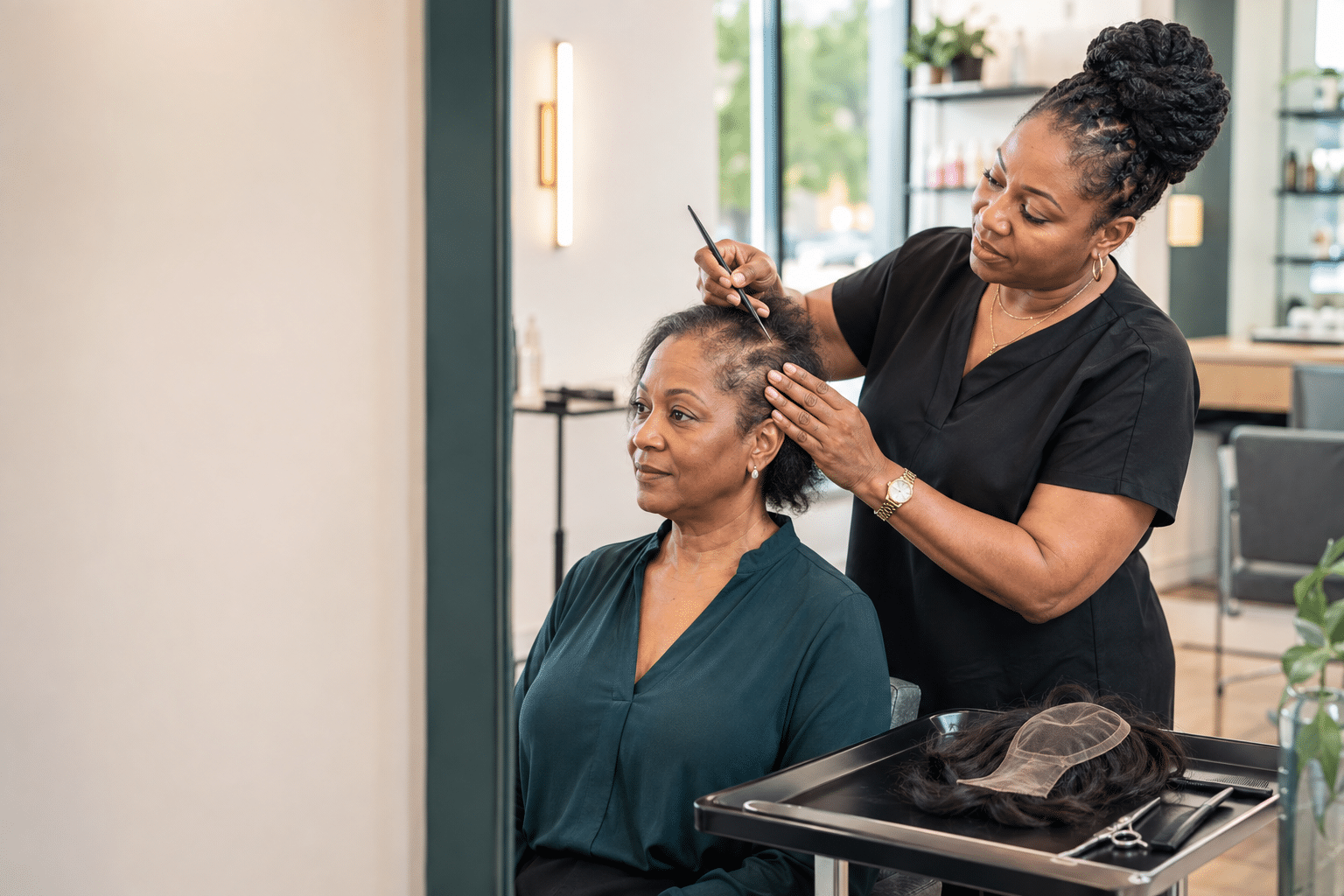
Deborah: The challenge is always making someone look totally natural for the period, action and setting of the film. It doesn’t always mean perfect or stylish. Sometimes “natural” means windswept or disheveled. It all depends on the storyline. The producers trust you to get it right. For eight years I worked with Kim Ferry (Dept. Head) on a TV show called “The Office” starring Steve Carell and an actor from the show named Leslie David Baker. Leslie was experiencing hair thinning and we were trying to figure out how to give him more hair for this role, so I went to a hair shop in Los Angeles called “His & Hers” and purchased a “rabbi beard” – I think that’s what they call it. Anyway, I took that beard and curled it with a fine curling iron and was able to mix in with his own hair to make it look thicker. We didn’t know how it was going to work, but he was a great sport and worked with us and in the end we got that hair piece to work. It actually looked real. But we knew that this was a temporary fix and there were other ways to give him a better look. That’s where my good friend EdMarie Masters came in. I knew the Baker quality of the hair replacement work EdMarie was doing, so I approached her and asked if she could do something special for Mr. Baker. She said, “absolutely” and was kind enough to come to the studio and take his measurements. EdMarie, why don’t you explain what you did next…
EdMarie Masters: After we measured him, and I’d noted his hair color and texture, I ventilated a small sample area to match against Mr. Baker’s own hair. Then I went back to finish ventilating the rest. I only had 24 hours to finish the job because they needed him on set early next morning.
Hair Authority: So, it’s not just styling skills you need; it’s imagination, production skills… and stamina!
EdMarie: You sure do.
Hair Authority: When I hear you talk about ‘ventilating,’ that’s a precise skill. It takes a lot of time and practice to get it right.
EdMarie: It really does. You need very good eyesight. Your eyes can get tired in as little as 30 minutes. Anyhow, together we finished the job. We made it work. The piece looked great. That was one of the most challenging things I’ve ever done, but it was a lot of fun. When we finished, we both were tired, but we decided to make two more hairpieces as backups to avoid any future panics during filming.
Deborah: We have to get our actors ready to shoot every day, sometimes by 7:00 or 8:00am, which means we have to be there by 5:00am. Well, one morning Leslie came in as usual and we put his piece on for filming. At the end of each day I’m supposed to take it off, clean it, block it, and get it ready for the next day. On this particular day, I went into the trailer waiting for Leslie to come in, and I waited and waited and there was no sign of him. So, I got hold of a PA and asked her, “Where’s Leslie? Ask him to come in so I can take off his hairpiece.” And she said, “I just saw his car leave.” So, I immediately called him and politely asked him, “Leslie, did you forget something?” He said, “Nope. I think I’ve got everything. I’ve got my keys, I’ve got my wallet…” That’s when I suggested, “Leslie, did you forget to take your hair off?” Well, Leslie was already halfway home and he was feeling comfortable wearing his hair addition and was more than happy to keep wearing it. And so he did that day… and for many more to come. In fact, he became a pro at styling and maintaining his hairpiece and could take care of himself when I wasn’t there.
EdMarie: Mr. Baker was happy to look after his hair. It became so natural he forgot he had it on. That was a big compliment to us because we worked so hard to make him look and feel good.
Deborah: We continued to learn together. We constantly tried different adhesives and one day found this tape that stayed on so well that Leslie took it with him when he was on vacation in Florida. In fact, he called to tell me, “I swam in my piece. I went in the pool. I went in the ocean.” Leslie now puts it on himself and he knows exactly how to do it. He’s excellent.
Hair Authority: Do some actors ask you to become their personal stylist?
Deborah: Yes, I have had that experience. One of the gentlemen I have a wonderful relationship with is Sinbad, the comedian. As a matter of fact, I just recently spoke to him. I have traveled with him and was his hairstylist for several years. I’m not doing his hair now, but we spent a lot of time together. He did a couple of TV shows, “Vibe” and a sitcom and I traveled with him to the islands for the Soul Music Festival. For five years our team got to have a vacation in the most beautiful islands in the world! I also became good friends with Jo Marie Payton after “Family Matters” and I remained her stylist for many years after the show. Those are just two examples of how things can change from working at the studio to becoming a friend and personal hairstylist.
Hair Authority: What about music videos. Is that an exciting field?
Deborah: Yes it is, but early in my career I did more photos shoots and commercials than music videos.
Hair Authority: Where do you go from here, Deborah? What’s next on your timeline?
Deborah: Four years ago, I tried to retire. I put in my retirement papers and was already to sit back and relax. Then I got a call from a friend saying they were doing a movie in Atlanta and asked me to be on the team. So, I called the people at the MPI (Motion Picture Industry) asked if I could “un-retire.??? Well, it’s now 2018 and I’m still busy. I love to work. I love hair. This past summer I worked on a movie called “Dolomite” with Carla Farmer, Lillie Frierson and a team of others. Carla was the department head and she gave Lillie and me the responsibility of styling all kinds of wigs from the ‘70s. We had large groups of background artists to style – 150, 200, 300 people that we had to wig at any given time. It was crazy. We had wigs hanging from the ceiling, we had wigs everywhere. Some of the extras were able to style their own hair, but we wigged most of them because it’s easier to wig people instead of using their own hair because that takes time, and time is money. Directors like to keep things moving.
Hair Authority: So much for retirement.
Deborah: Because I did not retire, I was blessed to work on another project called “The Last Tycoon” with a wonderful young woman, Theraesa Rivers. We did some fabulous hair from the 1930s and to our great surprise, we were nominated for an Emmy! I’ve always been a fan of old movies I’m constantly watching Turner Classic Movies and checking out the hair. It has helped me many times in my research for various projects.
Hair Authority: Congratulations!
Deborah: I was so overwhelmed, humbled and appreciative. I have watched award shows since I was a little girl, and always thought maybe one day, one day… And my one day just came!
Hair Authority: Sounds like things are heating up; not the relaxed schedule you were planning.
Deborah: That was a wonderful experience, but I’m going to start thinking about my retirement again, but there are a lot of stylists I have worked with over the years who still ask me to help out.
Hair Authority: We’ve talked about your career over the years, but what about the hair? How have the wigs changed over the years?
Deborah: Oh, my goodness. When I first took those wigs from Ron Smith, the netting was heavy and coarse. The hair was ventilated in different directions and you had to kind of maneuver and work around it. The wigs being made today are far above anything we could have anticipated. Even the synthetics are great now. You can use heat on them. Before, if you put an iron to those wigs, they would shrivel up. The fibers coming out of Japan are great. I have a personal wig that has gone through so much. I’ve steamed it, I’ve ironed it, I’ve curled it, I’ve done everything to it and it’s still standing, believe it or not.
EdMarie: As products become more sophisticated, you need more expertise. Many young stylists want to work in TV and motion pictures, but they don’t realize that work can start at 2:00 or 3:00 in the morning. Then there is the question of specialist training. Supply and demand are frequently out of balance because there are so few places that train new industry recruits.
Deborah: Yes, the entertainment industry is hard to get into. Fortunately, there is one journeyman, Susan Lipson, who is a seasoned stylist in film and television, who has an established school called “On Set” just for this. When people come into the film business from a beauty salon, they have to adapt to a whole different work ethic. It’s not an easy adaptation. The hardest thing for me was learning not to be a perfectionist. I am a perfectionist by nature and I want my clients to look flawless, but often the director does not want the hair to be perfect. Depending upon the storyline and the characters, sometimes it has to be messy, unkempt or dirty. That was hard for me because I was used to sending my clients out the door looking perfect. I had to learn how to let little hairs fly out and have wispies and things not laying down.
Hair Authority: We hadn’t thought of that.
Deborah: Depending on the character, we’ve had to put dirt in a person’s hair for example, to make it look like he was homeless. We’ve had to do dreads, braids, twists etc. And always with the clock is running. You may not have all the tools or material you need, so you have to improvise. There’s a fabric you can use as hair called crepe wool. It’s very convenient. It comes on a long strip and you just lay it down and trim it to size. It’s amazing the things that you come up with. You have to be quick on your feet. You have to think quick.
Hair Authority: And clearly you have to be able to work under pressure. It would be easy to lose your cool and panic.
Deborah: That’s so true. Now I’m going to tell you how I’ve weathered that storm. When things get really rough, I bring myself in spiritually. I know that God is watching over me and blessing the work of my hands. But my mother also shared with me when I was a young girl that this was a tough world and I needed thick skin to make it. I had just finished beauty school and was trying to get a job in the Bronx. All I wanted at the time was to work in one of those little salons, but everywhere I went they wouldn’t hire me. Later I found out that wasn’t God’s plan. He had a bigger picture. I was just starting, and He wanted to put me in another place where I could grow and learn. Since then, every experience, every place I have worked has trained me to give back. I’ve worked with all types of people from craft service to PAs to the executive producers and directors. But most of all, I hope, I have inspired other professionals in this industry and that my work has encouraged them to follow their dreams.
Hair Authority: Deborah, we could not think of a higher note to finish on. Thank you for sharing your story.
About Deborah Pierce – Deborah, a native of Yonkers, New York has been in the professional beauty industry over 41 years. Her career began in Manhattan where she attended Wilfred Academy of Hair & Beauty Culture. Shortly after graduation she became affiliated with Glemby International, who owned salons in various prominent department and specialty stores throughout the United States and Europe. The prestigious Bergdorf Goodman is where Debbie’s career was launched as a salon assistant. Lasting success does not come without sacrifice, so after years of hard work, Debbie was promoted to hair-stylist, then salon manager and trainer. An ambitious and determined nature would not allow her to stop there. As the bright and persistent young stylist continued to progress, she began to pave the way for others by conducting hair and beauty seminars, throughout the country and internationally, educating and motivating salon stylists with the latest techniques. Debbie also sharpened her skills by working as a platform artist and trainer for Roux Laboratories, Revlon Professional Products and United Airlines. She has volunteered her services to community organizations such as: The Girl’s Club of New York, The Junior League, Graham’s Home for Alternate Education, Leake and Watts Children Home and Rikers Island (Prison for Women). And for the past 28 years she has served as a Board Member and Treasurer for The Christian Cosmetology International Association (CCIA). Deborah is a 13-year breast cancer survivor who trusted God from the time she received the diagnosis to the last radiation treatment. Her accomplishments are proof that nothing is impossible, and no goal is unobtainable, if you dare to believe in yourself and persevere.
A resident of Los Angeles for over 40 years, Debbie is living out her dream of working in the entertainment industry.
She has worked on television, TV award shows and films such as: Glow (Netflix), The Last Tycoon (Amazon), Bones
(Fox), Last Week Tonight (HBO), The Office (NBC), Castle (ABC), Pretty Little Liars (ABC Family), Cedric The
Entertainer Presents (Fox Television),My Wife and Kids (ABC), One on One (UPN), That’s So Raven (Disney), The
Parkers (Big Ticket/UPN), The Steve Harvey Show (WB), Family Matters (ABC), Moesha (UPN), The Sinbad Show (NBC), Sinbad’s 70’s Music Festivals (HBO), Soul Plane (MGM), The Five Heartbeats (20th Century Fox), in addition to GRAMMY Awards, NAACP Image Awards, and the American Music Awards. Her work has appeared in publications such as Sophisticates Black Hair, American Hairdresser and Essence magazine.
“Family Matters” is an American sitcom series that originated on ABC from 1989 to 1997, before moving to CBS from 1997 to 1998. Having run for nine seasons, Family Matters became the second longest-running non-animated U.S. sitcom with a predominantly African American cast, behind only The Jeffersons (11). Having aired 215 episodes, Family Matters is ranked third, behind only Tyler Perry’s House of Payne (254), and The Jeffersons (253). (Source: Wikipedia)