Blog
The Thinning Hair Attachment Safety Guide

When More Hair Creates More Risk
WEIGHT, TENSION AND ATTACHMENT
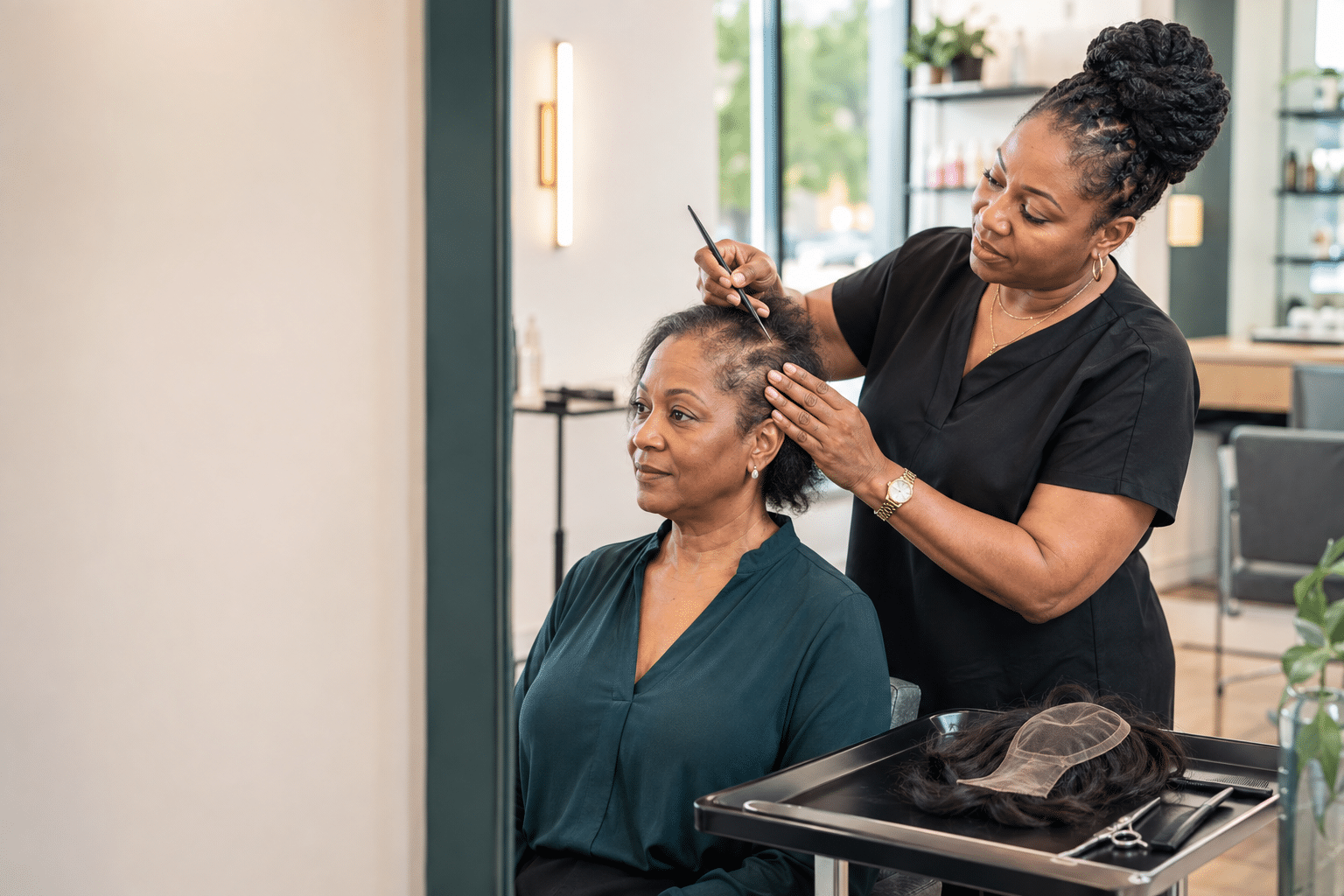
Added hair can provide immediate volume, but fine or actively thinning hair may have little capacity to carry additional weight. Safe practice begins with assessment—not attachment.
Clients with thinning hair often ask for the very services that can place the greatest stress on what remains. Extensions, integration systems and clipped toppers offer immediate coverage, yet each transfers weight or tension to natural hair and scalp. The fact that an attachment can be installed does not mean it should be.
Traction alopecia develops when repeated pulling damages follicles. Early changes may improve when traction stops. Prolonged stress can become permanent. The American Academy of Dermatology identifies tight braids, locs, buns, ponytails, weaves and extensions among the practices capable of causing traction-related loss, particularly when they produce pain or concentrate force at fragile margins.
For the thinning-hair professional, the central question is not simply “Which method is gentlest?” It is “What can this client’s hair safely support today?”
BEGIN WITH THE SUPPORTING HAIR
Assess density, strand diameter, elasticity, breakage and distribution. A client may appear to have enough hair overall while lacking adequate strength precisely where clips, beads, tape or integration points would sit.
Pay particular attention to:
- The frontal hairline and temples.
- Areas already showing miniaturization.
- Chemically relaxed, bleached or repeatedly heat-styled hair.
- Short broken hairs around former attachment points.
- Scalp tenderness, scale, redness or inflammation.
- Uneven density that forces too much weight onto too little hair.
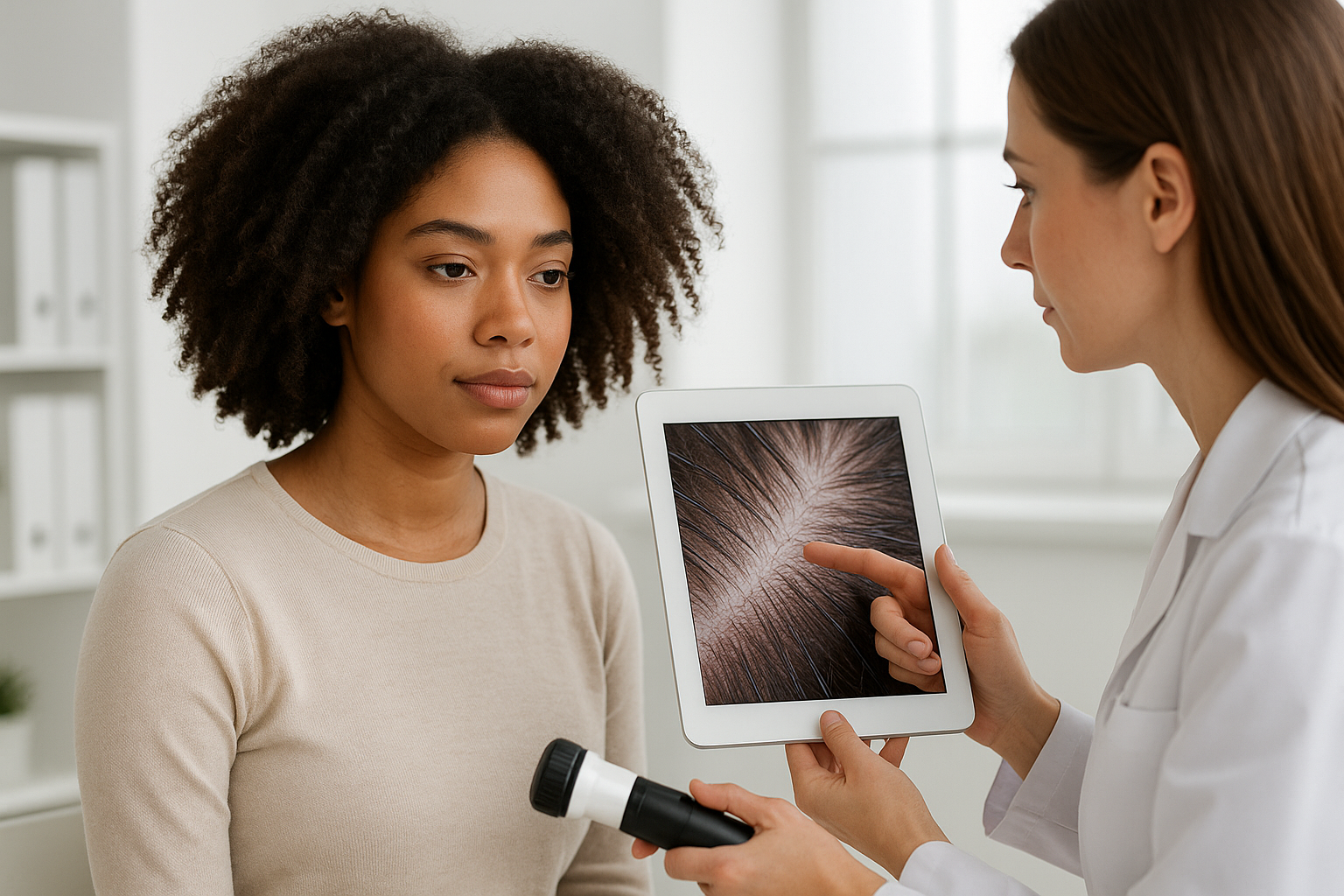
Do not disguise a medical assessment as a salon diagnosis. If loss is sudden, patchy, painful, inflamed, scarring or rapidly progressive, pause the cosmetic plan and recommend evaluation by a dermatologist.
PAIN IS NOT PART OF THE SERVICE
Clients sometimes believe tightness proves security. It does not. Pain, headache, stinging, crusting or visible “tenting” of the scalp are warning signs. AAD guidance recommends loosening or removing a style that hurts.
Ask during installation, after the client sits upright and again before departure. Pressure that seems acceptable for a few minutes may become intolerable after hours.
WEIGHT MUST BE DISTRIBUTED, NOT MERELY REDUCED
 A lightweight addition can still create a high local force when secured to a small number of strands. Conversely, a larger topper may distribute weight effectively if its attachment points rest in stronger areas.
Evaluate the complete system: base size, hair length, fiber weight, number and position of clips, direction of pull, movement during sleep and activity, and how often the piece will be removed.
Longer hair adds leverage. Wet hair adds weight. A client who exercises heavily or sleeps in an attachment creates different mechanical demands from a client wearing a topper for occasional events.
CHOOSE THE LEAST DEMANDING METHOD THAT MEETS THE GOAL
There is no universally safest attachment. Clip-ins are removable but can repeatedly load the same small areas. Tape spreads force but requires appropriate hair and careful removal. Beads or links create distinct load points. Sewn systems depend on the condition and tension of the supporting foundation. Adhesive attachment avoids pulling on natural hair but introduces skin-contact, cleanup and allergy considerations.
Sometimes the safest answer is a larger topper, a full wig or a non-attached option. Professionals should be willing to recommend less attachment even when it produces a smaller service ticket.
 PROTECT TEXTURE AND CULTURAL PRACTICE
 PROTECT TEXTURE AND CULTURAL PRACTICE
Traction risk is not distributed evenly. Curly and coily hair may be more vulnerable to breakage from rough handling, chemical relaxation and repeated tension. Yet professionals must avoid implying that clients caused a medical disorder through cultural styling. Conditions such as central centrifugal cicatricial alopecia require accurate diagnosis; healthy styling advice can reduce additional damage but does not replace medical care.
Consultation should be culturally informed and collaborative. Ask which styles the client needs for work, faith, sport, convenience or identity. Modify technique rather than issuing unrealistic instructions the client cannot or will not follow.
BUILD RECOVERY INTO THE SCHEDULE
Rotate attachment points where the method allows. Schedule removal and scalp inspection. Document redness, breakage and client-reported discomfort. Give fragile areas time without tension.
The client should know the stop signs:
- Persistent pain or headache.
- Stinging, burning or itching.
- Crusting, sores or discharge.
- New short broken hairs.
- Widening areas around attachment points.
- A change in the shape or tension of the scalp.
Immediate removal may be necessary. Medical referral is appropriate when symptoms persist, inflammation is present or loss continues.
WHAT TO TELL YOUR CLIENT
“My goal is to give you the appearance you want without asking fragile hair to support more than it safely can. If a method causes pain, persistent tightness or visible irritation, that is a reason to stop—not something you need to tolerate. Your best option may change as your hair and scalp change.”