Blog
Role Model


The Hair Authority Revisits Lucinda Beaty
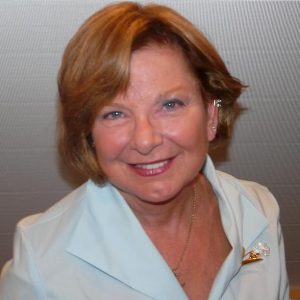
There is no need to introduce Lucinda. She attends workshops, shows and conferences everywhere. She has traveled to Asia to visit hair factories and to Washington to lobby for insurance reimbursement for hair additions, not to mention pressuring her local senators to extend barber’s rights to female cosmetologists. And she is not just a powerhouse in her chosen profession. Lucinda is also a competitive skier, rides a custom Harley-Davidson and for relaxation goes skydiving and scuba diving. There is not enough space here to chronicle all her contributions to the hair replacement and addition market, so we’re just going to let readers get to meet this remarkable woman in this informal interview.

Lucinda’s Hair Salon sign
Hair Authority: Lucinda, you are well-known to our readers because we’ve talked before about the good work you’ve done over the years. You’ve been involved in helping to craft and influence legislation and you have changed the focus of your business to help women suffering from cancer. What are your priorities today?
Lucinda Beaty: I focus my energy on hair loss solutions for people with special needs. I also give special attention to my staff many of whom have been with me for over a decade. We need caring people and it’s hard to find those people today.
Authority: Many people enter industry because they’ve suffered from hair loss themselves, but you have wonderful, healthy hair. What motivated you?
Lucinda: No, I actually suffer from Alopecia Areata. I’ve worn lots of hairpieces and wigs in the past, in fact, the first time you met me I was wearing a wig. However, I don’t have to do so now because my hair today is better than ever due to trichology. It’s growing in nicely. It’s slightly thicker and I have more of it. I still opt to wear hairpieces or wigs at times, like when put on a helmet to ride my motorcycle. Unfortunately, the minute I put on a helmet, voila, there goes my hair. It gets stuck to my head. Wearing a wig helps with this issue.
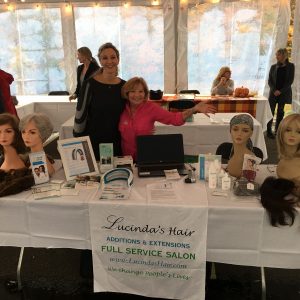
Lucinda at Alopecia Conference
Authority: You probably wear a helmet often, not only for the motorcycle, but also for skiing, rollerblading and all the other crazy stuff you’re into…
Lucinda: I have all the toys, but I’m a little more subdued now. I ride my bike less frequently these days because I’m older and I don’t want to get hurt. I used to have no fear in years past, none; but now I’m trying to be more cautious.
Authority: Playtime aside, how has your business evolved over the years?
Lucinda: I’ve done hair forever. And it sure has been a journey. I started off in the 60’s wanting to learn as much as possible and going to all the shows and workshops with people like Sassoon and the Chadwick’s. By the mid 70’s, I had set up shop with a partner and we had a staff of 12. Then in the 80’s, I moved to Connecticut because I wanted to open up a salon that was less chaotic compared to the usual open salons. I wanted a place that would allow me to have a more personal relationship with my clients.
[rml_read_more]
Authority: You then began to offer hair additions and hair replacement services. How did that journey begin?
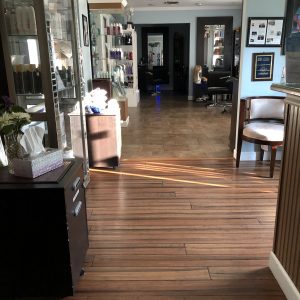
Spacious salon
Lucinda: One day somebody from my church who suffered from had Alopecia Universalis asked for my assistance. He needed me to make him a wig. I didn’t know what I was doing but I did my best, made a mold and sent it to American Hairlines who informed me that it wasn’t designed right because it didn’t have any temples or recession. I didn’t know a mold needed recessions as there was no education about things like this at that time. So, this became a pivotal moment in my career because I knew I wanted to help people, but I didn’t have the knowledge. I could see there was a real need at my church – this poor man had been wearing a bad wig for a long time and desperately needed help. So, I did my research and made another mold, this time with recession and a human/synthetic blend. When it came back, I cut it in to a man’s style and he was ecstatic. So, I said to myself, you know this is really rewarding. I’ve just learned something that can really help people. I started with the Alopecia client and then moved into other men’s and women’s hair loss situations and even children. I made a point of attending all the Alopecia conventions and the more I learned the more involved I became. Inevitably, business eventually involves politics and I joined a campaign to try and change the law so stylists like me could cut men’s hair at their beauty salon, which was a big thing. After a lot of campaigning we were finally successful.
Authority: Explain the issue about cutting men’s hair. It seems strange today that female stylists were not able to work on men.
Lucinda: I’m going to give the exact date the law changed; it was April 24, 1974. Before that, we were only allowed to work with women in the beauty salon. I had a group of clients who were all male ski instructors and I had to do their hair at my house because it was against the law to do their hair in my salon. Needless to say, this was inconvenient for me and for them. Barbers were licensed to shoeshine, shave and color and us hairdressers were only licensed to cut, singe, fringe, permanent wave and color women’s hair! It made no sense. We had to reach out to lawyers and go to institutions like Harvard to get support. The barbers fought us tooth and nail. They didn’t want us cutting men’s hair, but I we had powerful supporters and we were ready to fight to change the law – and we finally did in 1974.
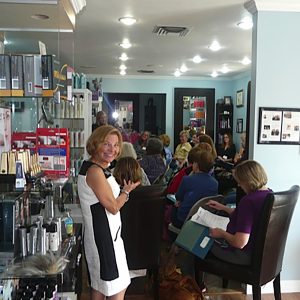
Lucinda Beaty hosts class
Authority: Other than protecting the male clientele, what was the logic, behind the barbers’ complaints. What’s different about working on a man’s head?
Lucinda: The barbers said that women shouldn’t cut men’s hair because the men would harass them and make passes. In court, we had to run through various scenarios and explain why this wasn’t an issue. When women have a scissor and a razor in their hands, they care about the hair, not sex. We were forced to prove that women stylists are creative artists who can cut not only women’s, but men’s and children’s hair.
Authority: You had to fight for many of the things we now take for granted.
Lucinda: This isn’t an easy industry. There’s always something we need to change, like getting women insurance coverage for prosthetics due to hair loss from chemotherapy. We had to fight for that. At the time, there were no provisions for chemotherapy patients to get their wigs covered. We had to go to the Connecticut State Capitol and protest and go to court and change the law. We eventually succeeded and now chemo patients who reside in Connecticut can get at least $350 reimbursed and sometimes more, depending on their insurance carrier.
Authority: For the longest time, it was assumed that you needed to keep thinning hair clients apart from the people who were having regular styling and coloring done because they would be embarrassed. How do you handle this?
Lucinda: It depends on the client. We have private rooms for our wigs and chemotherapy patients. We also have an open area. Generally speaking, people are ok being out in the open area if they are just getting their styled or hair colored. However, we find most people with hair loss want privacy.
Authority: A lot of managers of hair replacement studios would say their biggest problem is finding and keeping good staff. We started our discussion today with you telling us that two of your technicians have been with you for 14 years. What’s the secret?
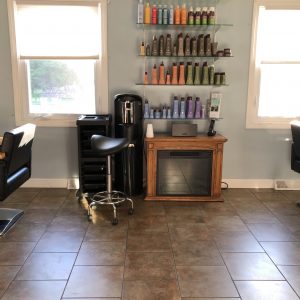 Lucinda: Simple. They like helping people. We’ve created a good environment here and our clients have become our friends. I also believe in building our technician’s skills, so I am happy to invest in their education. They also get paid well, including vacation pay because they deserve it.
Authority: What has your long career in hair replacement, taught you about the qualities a technician needs to be successful.
Lucinda: Number one, they have to be honest and have compassion. They also need to have a vision for each client in order to give them the best artistic look that they can. This job requires more than haircutting. It takes creativity, an artistic ability and a will to continue learning and growing.
Authority: Is the hair replacement industry now at risk because cosmetologists without those human qualities see a new profit opportunity but don’t have the experience to handle it?
Lucinda: No question. In fact, I’ve just had a woman study with me for three months. One day, we had a walk-in asking for a haircut and this woman did it. Well, I caught sight of the client as she was getting cashed out and I had to take her back and re-cut her hair because the student didn’t know a layered Bob from a wedge. I couldn’t believe it. So yes, it’s very difficult to find the right fit in this industry. This woman who had studied with me had all the right qualities on paper, but she simply didn’t have the natural skills. It’s difficult in the hair replacement industry to get somebody with skill, artistic ability, the desire for continued education to be on the cutting edge, while also being loyal and honest. Add to that the fact that they need to be able to work with people who have a special need and provide emotional support. That’s a lot to ask for.
 Authority: You have a close relationship with your clients not only because you’ve been through many of the same experiences, but also because your business and your home are close together. In fact, they couldn’t get much closer, could they?
Lucinda: They’re actually connected. I live and work here, but I keep them separate.
Authority: How big is the studio?
Lucinda: Although the building is quite large, it has a boutique atmosphere with large windows. We have five stations in the salon section, two stations out in the boutique for wigs and hairpieces, and then it also has a private room for the staff to have lunch and an office. We also have a large parking lot which makes it very convenient for staff and clients alike.
Authority: We would imagine that there is a business benefit when the owner is on the premises. You always know what’s going on and the staff had better arrive at work on time….
Lucinda: That is an advantage, plus I have surveillance cameras so I can look and see what’s going on wherever I am. That’s good for business and for security.
Authority: You are not located in a city center. Where do you draw your clientele from?
Lucinda: My clients come from all over from New England. Boston is two and a half hours away, New York is only an hour and a half. Vermont is anywhere from two to three hours away. Even New Hampshire and Rhode Island are less than two hours.
Authority: You are very active in social media. You post frequently on Facebook and you have a TV show as well. How important is this?
Lucinda: It’s become the backbone of the business. The TV show is on a local channel in the Cox Cable network that covers five towns. I bring on different specialists and doctors and we cover a variety of hair topics including chemotherapy, alopecia, and trichology. I have a great production crew and a talented editor. I’ve been broadcasting for over 15 years.
Authority: The industry is contracting at a rapid rate. We see a lot of mergers, acquisitions and joint marketing. Could you ever see your company becoming part of a network or a larger organization?
Lucinda: I am open to it. All that matters to me is making sure my clients get the best care possible. My clients come first. If a partner or associate could provide additional support or add new services, that’s a win-win for everyone.