Blog
Trade Show to Customer Service


How Hair Art Adapts
In 2017, The Hair Authority met with Roberto Gonzalez and Nancy Beltran, both of whom had recently joined Hair Art Products with a commitment to building a responsive, state-of-the-art customer service division. Six months later we met them again, this time behind the counter at the company’s new booth at the International Salon and Spa Expo (ISSE) in Long Beach, California. We asked Roberto how he prepares for a grueling three-day event like this and how he maintains that personal, one-on-one contact when people are lined up five deep with loud music blaring in the background.
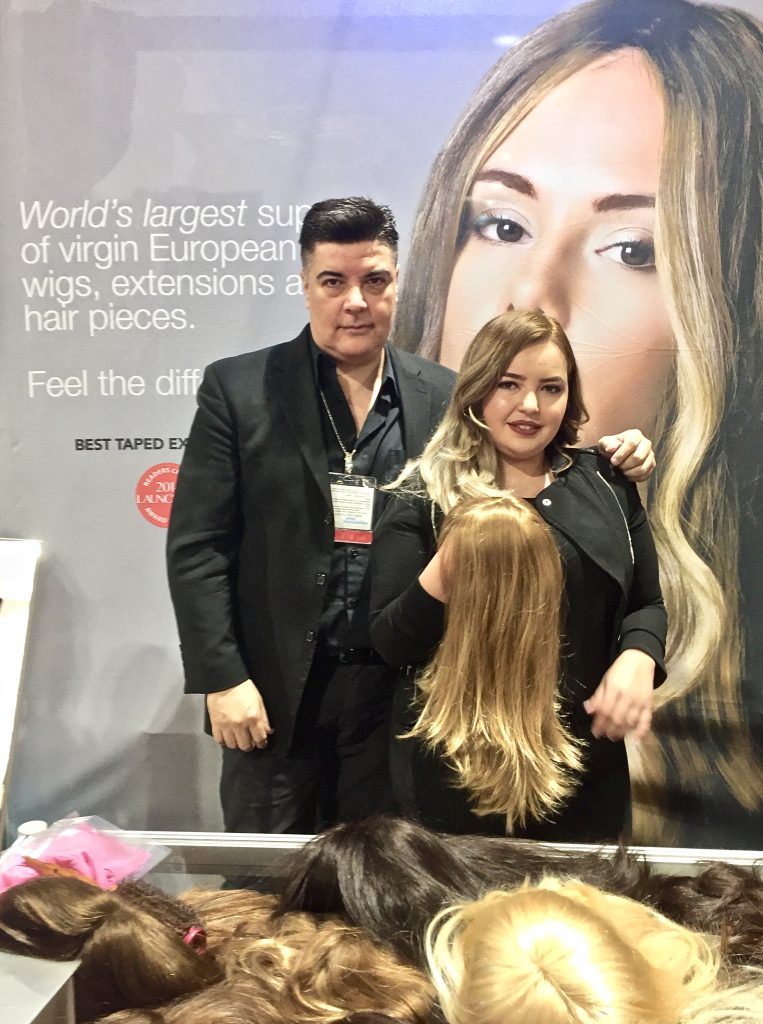
Hair Authority: Roberto, we were excited to see your stand at ISSE. You were in a great location right in the middle of the exhibition, but that central spot was a mixed blessing because you had to shout to get heard above the background noise. It seems your competition doesn’t just want a big piece of real estate, they also want to dominate the airwaves.
Roberto Gonzalez: You’re right. It’s certainly a multi-media competitive environment! How do we survive a trade show like this? Well, the first thing I can tell you is you have to be prepared for the audio pollution, it’s always excessive. Audio pollution not only distracts you, it blocks your creativity. Your intuition gets blocked and you feel overwhelmed. That’s why it is important to develop body language that communicates your desire to help instead of trying to shout out your product’s benefits. If you want to close an important deal, you really need to step away from the booth. Show your client you really care by taking them aside and listen closely to everything they have to say. Booths are for displaying your products and building a corporate presence, but it’s the one-on-one conversations where the real business happens.
Authority: Body language matters in the salon too. When Hair Club was developing its consultation procedures, they explained how to place a hand on the client’s shoulder to reassure him or her that you were in this together.
Roberto: I agree. People underestimate the importance of how to physically communicate with a client or business prospect. At a trade show, you are forced to be selective. You need to be careful not to waste your time. Some people go to shows just for the circus atmosphere, and there are others who are serious about expanding their business. You need to quickly determine who to spend time with. Every minute is valuable.
[rml_read_more]Authority: How can a visitor demonstrate that they are serious and deserve your attention?
Roberto: Good question. There are some companies that have their own employees act as though they are show attendees and they’re out there mingling with the public clapping and making noise to create attention and get the crowd to interact and get engaged with their business. So, don’t just follow the crowd or go to the noisiest booth. When you go to beauty shows, you need to know exactly what you’re coming for. Do your homework and make a list of what you need and what booths are you’re interested in. Otherwise, you’re going to be ending up in a no-zone and buying something you really don’t need. You can usually download the show or conference calendar and floorplan, so you will have all the tools you need to plan ahead. Take it from a pro, it’s time well spent.
Authority: What about body language for the visitor?
Roberto: Body language works both ways. It’s usually easy to identify an earnest client because they will look directly at you and try to catch your eye. But for the exhibitor, it’s more complex. Little things matter; things it’s easy to overlook. For example, you must have a clean mouth and fresh breath because you will need to get close to customers to get heard and if you have bad breath, believe me, they won’t pay attention to what you’re saying.
Authority: Do you dress like your clients to show you are one of them, or do you dress authoritatively so you look like a serious business person whom they are going to respect?
Roberto: As an exhibitor, you must dress to impress. Certainly, you can be comfortable – it’s going to be a long day – but you need to be up to their expectations. When you dress to impress, you’re building an impression of your business and showing that you’re a professional.
Authority: How do you start a conversation?
Roberto: Avoid saying “Hi” right away to everyone because it makes browsers feel uncomfortable. They don’t want to be greeted. The best thing is to let them interact with your booth in their own way. Let them engage with the product. Let them touch, feel, smell, taste it, whatever they want to do. Just keep an eye on them, checking to see if they have any questions, and only then talk about the product.
Authority: So, don’t accost them when they’re on the defensive. Let them get intrigued by the product and then answer their question.
Roberto: Absolutely. That way they get involved first. Then you ask, “What are you looking for?” Or “Is there something you’d like to know more about?” But better than that, you can also describe something they are looking at, “Oh, that hair you’re touching, it’s European hair… let me tell you about the difference between European and other kinds of hair.” Sometimes sales close when you’re not even talking. They like the product and they just take it, and the only thing you do is say, “You like this? You want another one? You want to try that one?” And then sometimes at these audio-polluted trade shows, you can’t communicate with each other at all and the product has to do the talking.
Authority: They say that if the product is that good, the only thing a consultant do is talk the customer out of a sale.
Roberto: Absolutely right.
Authority: Hair Art had a major display at this year’s show, probably its biggest ever. On each side of the booth, you were promoting a different product. You had extensions, women’s wigs and extensions, men’s hair replacement services and even styling demonstrations going on. How was the booth designed?
Roberto: It was very different and successful design. There were different sections on our booth, one for wigs, tops and hairpieces, another for extensions. The extensions area was always busy and interactive with customers putting in extensions and our technicians showing them how they’re worn. Then we had another area for the Razarte razors that we’re developing with a Japanese company. And, of course, we set aside space for all the special gear for salons like irons, dryers, bottles, appliances; you name it, we have it at Hair Art.
Authority: Sounds hectic. How many people were on your stand?
Roberto: It was a challenge to display and demonstrate all our products, so we divided things up. If someone asked for a tape, for example, or extensions, I would introduce that customer to the people best equipped to assist them. That really helped us because every visitor got specialized attention.
Authority: The products, of course, were only one part of the equation. You also had a celebrity stylist on your stand. Who was he?
Roberto: His name is Ron King and he is the master-stylist for our company. He is a very demanding hair stylist; he knows what he wants – and he wants it now! Time-management is important in today’s world because customers are always in a hurry and that’s something Ron King understands. When you get to know Ron, you see how disciplined and professional he is. He can do a cutting and taping of extensions in less than 15 minutes, when a salon normally takes a couple of hours. Every second for him is important and every customer is important. I was impressed that even when there was a long line of people waiting to be served, he always had a smile for everybody. That’s key for Hair Art because we are committed to customer service and having everyone, customers, associates… and employees… leave with a smile, that’s exactly our goal.
Authority: Your booth had a banner “The only company offering 100 percent European virgin hair.” Tell us about that.
Roberto: Correct. In the human hair business, everybody claims to have “Remy” hair. They use words like, “Remy Hair” and “Human Hair,” but they don’t tell you the source of the hair. Now “Remy” simply means the cuticle on each strand of faces in the same direction and most Remy hair actually comes from China, India, and sometimes South America. These are countries where people have dark hair, so all this Remy hair needs to be processed and bleached so it can be dyed to the color the client needs.
Authority: So ‘Remy’ simply means intact hair that’s been aligned so the cuticle doesn’t snag.
Roberto: Correct. It’s not mixed up. The cuticle faces in the same direction.HEH Booth
Authority: But it can come from anywhere?
Roberto: Absolutely.
Authority: But your slogan says, “European Hair.”
Roberto: That’s right and it means our hair comes from Europe in its natural color and with its cuticle intact. It’s virgin hair; and when we say, “virgin”, it means the color is totally untouched.
Authority: Are there any circumstances where you have to adjust the color?
Roberto: Yes, occasionally we have to fine-tune color to meet a client’s special need or request. But we do this in strict quality-control conditions. The key to keeping healthy hair depends on how well you treat the cuticle. So, when you are lifting or depositing color to match a specific shade in a color swatch, the cuticle must always be protected. That’s when working with virgin, cuticled hair makes is such an advantage. This is especially true when you are working with hair colors that are difficult to find in their natural state, such as pale or reddish blondes. In these cases, we carefully lift the color with a patented technique that does not compromise the hair shaft’s natural protection. As we noted earlier, cuticled hair extends longevity. Darker hair colors such as 2, 4, 6, 8, 10, 12 and, less commonly, 14, typically remain untouched.
Authority: If an extremely discriminating client wants the absolute best, and let’s say he or she is a medium ash blonde hair, what would you propose?
Roberto: We never profile our customers, but we let them know that if they’re Caucasian for example and have European hair, then Chinese hair is not going to provide the best match. It’s a matter of genetics. Chinese hair would be too thick and heavy. It would look wiggy.
Authority: If price was a consideration, could a customer still get virgin hair from Asia or from India?
Roberto: Well, you can get colors like 1, Color 2, Color 4, but there is no natural, blonde in China or India. They need to chemically process the hair. European hair on the other hand is usually lighter, and even if you lift the color, the hair is really resistant because it’s cuticle is intact. When you have European hair, it is not only lighter in color, it’s also lighter in weight. Don’t take me wrong, Remy hair is beautiful. People often like it because it gives them more body and volume. If that’s what they want, they can get it.
Authority: But it’s not the perfect match.
Roberto: Correct.
Authority: You also offer hair at different price points. Could you describe the different choices?
Roberto: Absolutely. Let’s start with top pieces for integration. These are single pieces. We have one called “Joyce” and the price range with European hair would be around $1,000. Then we have our crown extensions and semi and three-quarter wigs that we carry as toppers for people with no hair. When we refer to toppers, it’s something customers want to apply quickly and easily to add volume. It’s a challenge to design something for people with no hair, so we created a new line called “Doris” which is a triple play – it’s for clipping, bonding or taping, anyway you want it. And for added undetectability, it’s got a French top, which means no return hairs. People like no returns because there’s no knotting so you can see the scalp. If they want to have a French top with volume, we just add the returns, no problem. This is a luxury piece for people with no hair.
Authority: The directors of Hair Art wear their own hair, design their own hair, manufacturer their own hair, distribute their own hair, and own studios that work with customers who also wear their hair. They’re involved at every stage of the process.
Roberto: There’s no company in the world who does what we do. Other companies may travel to China or other countries and visit the factories and, if they like the samples, start buying from them. We do things differently. Why? Because here the process begins with the hair. We select the best hair right upfront here in California. We select it, we clean it, and only then do we send it to the factory to work with. We know exactly what to expect. There’ are no surprises and, guess what, sometimes, when we have preorders, our customers actually get to see and select their own batches of hair in advance. They become part of the planning and know exactly what to expect.
Authority: Do your studios and technicians provide feedback to the designers and production centers?
Roberto: Absolutely. We get feedback from the stylists who work every day with their customers, but we also turn to our stylists and technicians to test new designs. That’s one of the huge advantages of owning your own hair replacement centers. We can send out new products to see what our customers think about them and how our stylists react. We are very customer oriented. Customers can help us plan ahead and they can work with us to fine tune their new hair systems. They can say, “I want this pattern and this molding.” They can choose the sample of hair and specify the color they want. They even tell us how wavy they want it. I haven’t seen that in any other company, but we can do it. If they want it straight, a 30-millimeter wave or a 20 tight curl we’re ready. And remember, that’s natural hair we’re talking about. It’s not permed. It’s natural hair. So, they select the hair in advance and we process those preorders for them. Taking things one step further, we will even private label their product if that’s what they want.
Authority: That’s a lot to remember.
Roberto: Let me summarize it for you. We have three ways to do business with our clients. No. 1 -They get it fast. If it’s not a custom order, they can even have it the next day. No. 2 – You like this product, you can make some changes when you preorder. You don’t need to buy them all in advance. I can even private-label them because they are your own creation. No. 3 – Custom pieces created from scratch. Other companies don’t do that. They typically “customize” their own designs. We don’t. We can make your own design from scratch.
Roberto: We started this discussion talking about conferences and trade shows and I’d like to add one final suggestion for exhibitors when they are in a trade show. It’s something funny but it’s very real. Your best sales are often in the last ten minutes. Sometimes exhibitors are tired and start packing half an hour before the end of the day, but that’s when the real sales can start because but you’re now free to talk to prospects and give them your full attention. But be aware that that’s also when your competitors are out browsing each other’s booths, so know who you are sharing your product information with.
Authority: Good advice. Looking over the Hair Art horizon, what can we expect in the months ahead
Roberto: One of the first things I would flag is our inventory, the volume of products we always maintain in inventory. We are against back orders. We don’t like BOs here, so we’re being very aggressive about stock cover. We are guaranteeing that we’ll always have your hair available. You place an order and you’re going to get it from Hair Art in 2018. If you’re trying to increase profits, you can’t sit around waiting for product. If any salon owners reading this article are waiting for hair from another company, we hope they will give us a try when they have a back order. We can probably supply that color that they’re looking for. Their customer doesn’t have to suffer waiting for three, or four, or six months. I know that this year, there is a shortage of human hair, especially long European hair. And if you have a lighter color, it’s almost impossible to find. But we probably have it in stock. And the good thing about our hair is that it’s carefully wrapped and stored. It doesn’t oxidize.
Authority: Final question. In one sentence – Looking back on last year, what are you most proud of?
Roberto: Networking, not selling but networking. My customers are seeing profits from networking. How does this work? When we have end-users interested in our products, we refer them to our clients, and those clients become our distributors. The pyramid is growing wider every day. Let me give you an example. Because of Ron King and his social media videos, our Invisi-Tabs are becoming very trendy. People contact us to ask for those extensions. But, when they call Hair Art, we take all their information and tell them, “We cannot sell to you directly, but we’ll refer you to one of our contacts.” Then we’ll call a local studio and say, “Hi, Jack. I’ve got a customer in your area. She’s looking for the following item. I know you don’t have it, but I’ll send it overnight. Here’s her information, go ahead and schedule an appointment.” We connect. We create a new customer for them and they get the business. That’s why studio owners trust us. We are building a network and we are feeding that network with our own demand. Other companies typically say, “We are wholesalers, we don’t sell to the public” and they hang up, but we think there’s a better way!
Authority: That’s a great note to finish on.