Blog
When Less Is More


Hairline Lowering / Forehead Reduction Surgery – Dr. Epstein
 Dr. Epstein’s website provides a perfect introduction to a doctor who is a medical and personal care innovator, “Dr. Jeffrey Epstein is one of the most highly regarded hair transplant specialists, but also is recognized for his work in plastic surgery procedures, in particular hairline lowering.” The Hair Authority met with Dr. Epstein to learn more about the benefits of integrating hairline lowering into hair restoration procedures to create more natural looking results.
Hair Authority: Dr. Epstein, we are eager to learn about the hairline lowering surgery that you are helping to pioneer, but before we ask you to describe this procedure, we’d like to ask for your thoughts about the life-changing benefits of the work you are doing. We’re hearing a lot of discussion in academic circles these days about doctors and medical advisors trying to measure or understand happiness. At the same time, there is a powerful consumer trend towards meditation and “being in the moment.” How does the work you do fit into this changing landscape?
 Dr. Jeffrey Epstein: Hair is fundamental to the way people feels about themselves. Change or improve their hair density or hairline, and you can change a life- for the better if done properly.
Hair Authority: The hair restoration industry has matured and distanced itself from the period when the different disciplines were fighting among themselves for a slice of the hair-management pie. Professionals now recognize that there are multiple solutions and many of them work best when combined with other procedures. Merck and Pfizer made this clear when their drugs, far from threatening the established hair loss market actually expanded it. And several years later we saw robotic assistance in hair transplant procedures confront the same challenges before becoming accepted as an aid to greater accuracy and precision.
Dr. Jeffrey Epstein: Your preface is spot on. There has been an increase in the number of studies being done to measure outcomes, based not on how much hairline lowering there is, or how much more hair density there is, but on actual patient satisfaction. It’s a big area of inquiry right now, not just for hair, but for cosmetics and medicine in general. Professionals from all backgrounds are examining how they can positively and measurably improve the quality of one’s life. There are analytical studies being undertaken using objective measurements. In fact, we are about to start one ourselves. It’s fascinating that you bring this up, because we’re looking at procedures we’ve done, and ways we’ve treated patients and we’re actually trying to measure outcomes of patient perception. It’s not just a gimmicky like, “Oh, 80 percent of patients were satisfied,” but truly looking at standardized, well-studied, objective measurements of patient happiness, and seeing how much that satisfaction, peace of mind and confidence ultimately contributes to happiness.
[rml_read_more]
 Hair Authority: Cosmetic surgeons have always felt they are in the business of creating confidence… perhaps even creating happiness. So, if forehead reduction surgery can improve somebody’s wellbeing and produce a better life, that’s a great place to begin our conversation.
Dr. Epstein: I see those life-changing moments every day.
Hair Authority: How did you first introduce the forehead reduction procedure?
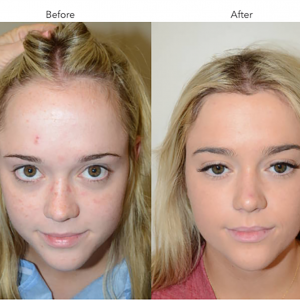
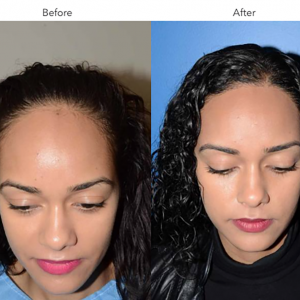
Dr. Epstein: I’ve actually been doing these procedures for over 20 years. I’m a facial plastic surgeon. I entered the field of hairline restoration after doing a fellowship with Dr. Sheldon Kabaker in San Francisco. He is really the innovator of this technique. He calls it ‘hairline lowering forehead reduction surgery.’ Since then, it’s always played a part in my practice, but it was never very big. I would maybe do two or three surgeries a year. But around four years ago, it really began to take off. People became more aware of the transformational effects of hairline lowering, due perhaps to the work that Dr. Kabaker-and I- were doing. I also wrote a paper on it in Hair Transplant Forum International and started publishing some results on my website. Then, at the end of 2016, I revisited Dr. Kabaker for three days, just prior to his retirement, to see how he had advanced the procedure and that turned out to be really productive. Over those three days, we did five surgeries and I saw multiple little nuances that can make the surgery more successful. I immediately started incorporating them into my procedures and began writing about them to share my experience with other doctors. I’ve come to love the procedure. It’s my favorite thing to do because it’s so transformative. In 90 minutes, you can take someone who’s lived their entire life wearing bangs or hats and in a single procedure lower her/his hairline by as much as an inch or more. And the next day, literally, other than the fact they have small stiches in their hairline, they’ve got a lower, slightly rounded out hairline which is unsurpassed in density!
Hair Authority: How are other doctors reacting?
Dr. Epstein: More and more of my colleagues are recognizing the value of this procedure. Many of them have sent me patients, some of whom were dissatisfied with the original transplant density due to the limits of hair transplants in some patients. More commonly, these are female patients born with a genetically high hairline that are seeking a more balanced appearance to the face, with density that exceeds that which can be achieved with transplants. Whatever their circumstances, these are amongst my happiest patients. It’s pretty amazing when you can get a result like that not in a year, but in literally a day. For the right patient, it’s a game-changing procedure.
Hair Authority: Is this a viable procedure for someone with traction alopecia?
Dr. Epstein: There is an indication for this as well, but only if the traction alopecia has created a high hairline. The most common reason we’re seeing patients is genetically high hairlines. This applies to both women and men. However, with men, I need to wait until they’re at least 40, 45 years old unless they have a zero family history of hair loss. I will always carefully evaluate them to see if there is any evidence of miniaturization of the hairline hairs that would suggest future progressive hair loss. The occasional patient at risk of future hair loss must understand that once his/her hairline is surgically lowered, if their hair were to recede later, there would be an exposed fine-line scar that would need transplants to cover it up. There are some people, such as celebrities in Hollywood or models whose careers revolve around their looks, but most of my patients tend to be women with genetically high hairlines. There is also a small group with medical conditions like scarring alopecia or cicatricial fibrosing alopecia that can affect the frontal hairline and I can lower the hairline to remove the areas affected by scarring.
Hair Authority: Is there any downside to this surgery?
Dr. Epstein: Very little. You get a fine line scar, but the incision is designed so hair grows through it, and most patients do not require any further grafting to conceal the scar as it heals so well. There will also be some numbness behind the incision because nerves from the forehead pass through here – however, they typically regrow, and sensation returns within a year.
Hair Authority: When you lower a hairline, you are recalibrating the whole face. Leonardo da Vinci argued that there exist ideal proportions and ratios for the perfect human face. How does this apply to the work you are doing?
Dr. Epstein: That’s a really good point. Some patients are aware of these notions, but the rule of thirds; one third, one third, one third, doesn’t universally apply here because the ideal hairline varies with age, facial structure, sex, and individual concepts of beauty. I have a high hairline and it looks perfectly appropriate. I don’t want the hairline of a 30-year-old. There is another factor we like to measure and that is where the vertical forehead meets up with the horizontal scalp; this 15-millimeter zone is where I usually like to place the center hairline. Most patients are not looking for any degree of recession; they want a relatively flat, or even a slightly rounded hairline, particularly women. With some patients I’ve placed the hairline as low as five centimeters above the nose. Other patients are seeking seven to eight centimeters. A lot depends also on where they’re starting from. For example, an African-American woman who has a hairline that’s 10 centimeters up might be delighted if it were brought down to seven and a half.
Hair Authority: It’s commonly said that at age 30, an average man has lost 30 percent of his hair density and at 40 it’s 40 percent and so on. Is there a similar scale for hairline recession?
Dr. Epstein: I don’t think there’s a hard rule, but that would be an interesting thing to study.
Hair Authority: A member of the public reading this might be wondering, “Could this be a procedure for me?” What is involved?
Dr. Epstein: Well, it’s a surgical procedure. The anesthesia is similar to what you would have for something like a colonoscopy, which is twilight sedation. The patient is breathing on her/his own, but basically sleeping and won’t feel or remember anything. The most important part of the process is actually the consultation; making sure they’re a good candidate. They must have realistic expectations and have sufficient scalp laxity. If someone can push their frontal hairline down 15 millimeters, that usually means that I can surgically advance their hairline around 20 millimeters or almost an inch, using certain maneuvers to further loosen it.
Hair Authority: Any other upfront requirements to qualify?
Dr. Epstein: Yes. The second requirement is to have a stable frontal hairline. In other words, if there is already thinning, they are not a good candidate. People who are at risk of thinning and receding in the future are not good candidates. Thus, many men are not appropriately treated with this hairline lowering surgery.
Hair Authority: Are you removing tissue, or are you moving and implanting hair lower down into existing tissue?
Dr. Epstein: The entire frontal hairline gets advanced downwards and forward, so I’m removing the overlapped area of frontal forehead skin.
Hair Authority: So, this could be a finishing touch after a regular hair transplant.
Dr. Epstein: Yes, in fact patients who have had a hair transplant and now have a reasonably dense hairline are excellent candidates because that transplanted hair is permanent. They’re not going to lose that hairline.
Hair Authority: Is this a complicated and expensive procedure? You make it sound quick and easy.
Dr. Epstein: When you do three of them a week, you become proficient. We have specialized instruments that let me undermine the back of the head all the way back almost down to the neck. I’m literally going all the way behind the head to free up all those attachments. The procedure itself takes around 90 minutes to perform. The recovery is quite easy. Most of my patients are able to resume non-strenuous activities two days after the procedure. Many of them are already used to covering up their hairlines, so they simply continue to do this for a short time until the stitches then get removed a week later. The typical cost of the procedure, including anesthesia, is between $6,500 to $8,500. Sometimes these patients wind up getting hair grafting as soon as three months later to further shape and round out their new hairline.
Hair Authority: Many people, ourselves included, were not aware of this procedure, but it appears it is now getting discovered. How is this happening? Is it just word of mouth?
Dr. Epstein: Word of mouth and sites like “RealSelf” is how patients can learn about the potential benefits of this procedure. Meanwhile, experts in the field of hair read about the latest procedures in journals such as yours. I have written a number of articles and given lectures to plastic surgeons and the International Society of Hair Restoration Surgery. I should add that this procedure also has applications for transgender patients, so there’s interest there as well. It’s just a matter of getting the word out. More and more of my colleagues are becoming aware of the benefits for their patients and I’ll sometimes perform hairline lowering surgery for them. Most of the professionals who refer patients to me are themselves top hair transplant surgeons, people like Drs. Ron Shapiro, Dan McGrath and Scott Boden: these guys are all leaders in the field. I continue to do hair transplants myself, but I always send this doctor-referred hairline lowering patients back to their referring doctor for subsequent hair grafting.
Hair Authority: What comes after hairlines? Could it be eye lifts? When you look at the human head, your hair is just a frame for the face, maybe 30 percent of your persona. Admittedly it’s where aging is first perceived, but you’ve only solved half the problem if you fix the thinning hair but still have baggy eyes and hollow cheeks. Is this a logical next step for a doctor like yourself?
Dr. Epstein: Good question Chris. I sometimes perform browlifts simultaneously with the hairline surgery. I used to do a fair amount of rhinoplasty and some eyelid and neck surgery, but over the last three or four years I’ve seen such an evolution in hair restoration – FUE in particular- that I’ve chosen to focus my attention on this very exciting field. And quite frankly, when you do something every day and you get better and more and more proficient at it, it becomes even more enjoyable. So, when I go into the office and do an FUE hair transplant or an eyebrow transplant or a female hairline lowering surgery, those are great days for me.
Jeffrey Epstein, MD, FACS, FISHRS, Assistant Clinical Professor, University of Miami. Board Certified, Facial Plastic Surgery, Hair Restoration Surgery, and Otolaryngology. Founder and Director of the Foundation for Hair Restoration and Plastic Surgery, with offices in Miami and NYC, Dr. Epstein has more than 25 years of experience as a hair transplant surgeon. He publishes and lectures extensively and is frequently featured in the media and press. He also provides pro bono reconstructive surgery to children and other people of need.
_______